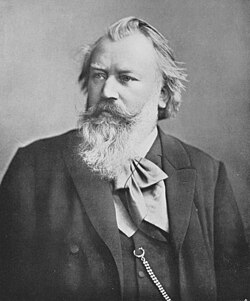
Hungarian Dances
The Hungarian Dances by Johannes Brahms, are a set of 21 dance tunes based mostly on Hungarian themes, completed in 1879. They vary from about a minute to five minutes in length. They are among Brahms's most popular works and were the most profitable for him. Each dance has been arranged for a wide variety of instruments and ensembles. Brahms originally wrote the version for piano four hands and later arranged the first ten dances for solo piano.
There was much interest in the 19th century for folk music. Both Haydn and Boccherini refer frequently to gypsy music, but in Brahms' day it was Franz Liszt with his Hungarian Rhapsodies who was an inspiration to Brahms, both artistically and financially (despite their differences in musical philosophy). In 1850 Brahms met the Hungarian violinist Ede Reményi and accompanied him in a number of recitals over the next few years. This was his introduction to "gypsy-style" music such as the csárdás, which was later to prove the foundation of his most lucrative and popular compositions, the two sets of Hungarian Dances (published 1869 and 1880).