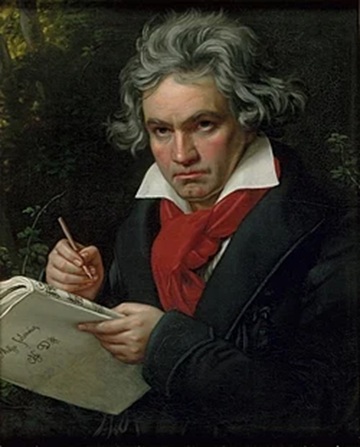




Symphony No. 5 in C minor
The Symphony No. 5 in C minor, Op. 67 (occasionally known as the Fate Symphony, German: Schicksalssinfonie), is a symphony composed by Ludwig van Beethoven between 1804 and 1808. It is one of the best-known of all symphonies and one of the most frequently played. First performed in Vienna in 1808, the work achieved its strong critical reputation not long afterward; E. T. A. Hoffmann described it as "one of the most important works of the time".
The 5th Symphony has 4 movements. It begins with a distinctive 4-note "short-short-short-long" motif, often characterized as "fate knocking at the door", the Schicksals-Motiv (fate motif). Sometimes this motif is remembered as "da da da DUM". Unusual for the time, this motif reappears in difference guises throughout the rest of the symphony.
During World War II, this famous four-note opening motif matched the Morse code for the letter "V" (dot-dot-dot-dash) and became an Allied symbol of resistance and the "V for Victory" campaign. Using a German composer's music as an Allied rallying cry turned a cultural touchstone into a symbol of anti-dictatorship solidarity and freedom.
The fourth movement dramatically shifts from C minor to C major, and to emphasize the drama of the moment, Beethoven expands the orchestra with the addition of piccolo, contrabassoon, and three trombones. In one master stroke this extended the orchestra's high, low, and dynamic range. It paved the way for the expanded orchestra of the Romantic Era in the 19th and 20th centuries.
The 5th Symphony falls squarely within what is called Beethoven's "Middle Period" of composition, starting from about 1803, when Beethoven chose to launch new works of unprecedented scope and ambition, often emphasizing the musical portrayal of heroism, as in the 3rd Symphony and the opera Fidelio. The process of composition for the 5th Symphony was lengthy and had frequent interruptions; the first sketches date from 1804, following the completion of the 3rd Symphony. Beethoven repeatedly interrupted his work on the 5th to prepare other compositions, including the original version of Fidelio, the Appassionata piano sonata, the three Razumovsky string quartets, the Violin Concerto, the Fourth Piano Concerto, the Fourth Symphony, and the Mass in C. The 5th and 6th Symphonies were completed simultaneously during 1807–1808, and both premiered at the same concert.
Beethoven was in his mid-30s during this time; his personal life was troubled by increasing deafness. In the world at large, the period was marked by the Napoleonic Wars, political turmoil in Austria, and the occupation of Vienna by Napoleon's troops in 1805. The symphony was written at his lodgings at the Pasqualati House in Vienna.